The Over Shoulder Look: Why This Simple Shot Transforms Your Visual Storytelling
Have you ever watched a film and felt an instant, almost physical connection to a character, as if you were right there in the room with them, sharing a secret or facing a threat together? That magnetic pull, that unspoken intimacy or tension, is often masterminded by one of cinema’s most powerful and enduring tools: the over shoulder look. It’s more than just a camera angle; it’s a psychological doorway. But what exactly is the over shoulder look, and why does this deceptively simple composition wield such immense power over our emotions and attention, whether in a Hollywood blockbuster, a intimate YouTube vlog, or a compelling advertisement?
This comprehensive guide will dissect the over shoulder shot from every angle. We’ll journey from its historical roots to its modern digital applications, explore the precise technical craft behind executing it perfectly, and unravel the profound psychological impact it has on viewers. You’ll learn when to use it, when to avoid it, and how to leverage it to create more dynamic, engaging, and professional-looking visual content, regardless of your budget or equipment.
1. Defining the Over Shoulder Shot: More Than Just a Perspective
At its core, an over shoulder shot (often abbreviated as OTS) is a camera angle framed over the shoulder of one character, pointing toward another character or subject. The shoulder and part of the head of the foreground figure are deliberately included in the frame, creating a literal and figurative “frame within a frame.” This immediately establishes a point-of-view (POV). The audience is not merely observing a scene from a neutral, omniscient position; we are being given the perspective of the character whose shoulder we see. This simple act of framing is a pact with the viewer: “See what they see. Feel what they feel.”
The magic lies in its dual function. First, it physically connects two subjects in the frame, visually linking them through the shared space of the foreground character’s shoulder. Second, and more importantly, it psychologically aligns the audience with the foreground character. We are placed in their literal shoes, making their reactions to the other person or object our own. This technique is a cornerstone of continuity editing and classical Hollywood style, providing spatial clarity while deepening narrative immersion. It answers the fundamental questions of who is looking at whom and what is being seen with elegant efficiency.
The Anatomy of a Perfect OTS: Key Components
Executing a flawless over shoulder look requires attention to several critical elements:
- Foreground Element: The shoulder and head of the character in the foreground must be positioned correctly—usually in the bottom third of the frame—without dominating the scene. The focus must be razor-sharp on the background subject, with the foreground figure often slightly out of focus to maintain visual hierarchy.
- Background Subject: The person or object being observed should be well-lit and composed, typically occupying the center or opposite third of the frame, creating a balanced dialogue or confrontation.
- Eyeline Match: This is non-negotiable. The direction the foreground character is looking must perfectly match the angle from which the camera captures them. If they look screen-left, the OTS must be positioned to the left of their face. A mismatched eyeline shatters the illusion and reminds the viewer they are watching a constructed scene.
- Lens Choice & Distance: A standard lens (35mm-50mm equivalent) is often ideal, as it mimics human vision and avoids the distortion of wide-angles or the compression of telephoto lenses, which can alter perceived relationships and spatial dynamics.
2. A Brief History: From Silent Films to Streaming Dramas
The over shoulder shot wasn’t always a staple. In the earliest days of cinema, static, wide “proscenium arch” shots dominated, capturing entire scenes from a fixed, theatrical distance. As filmmakers like D.W. Griffith pioneered continuity editing in the 1910s to create seamless narrative flow, the need for clear spatial relationships and character perspectives became paramount. The OTS emerged as a solution to show a character looking at something and then show what they see, all while maintaining a coherent screen geography.
By the Golden Age of Hollywood, the technique was codified. Directors like John Ford and Howard Hawks used it masterfully in Westerns and film noirs to establish power dynamics in confrontations. The shot became a visual shorthand for dialogue, debate, and discovery. Consider the tense, smoky conversations in The Godfather (1972); a significant portion of the film’s iconic power comes from the careful use of OTS shots that make us feel like we’re huddled around the table, privy to the family’s darkest decisions.
The French New Wave and auteur directors of the 1960s and 70s sometimes subverted or abandoned the classical OTS in favor of more discontinuous editing to provoke thought, but its utility ensured its survival. Today, in the era of prestige television (Breaking Bad, The Crown) and digital filmmaking, the over shoulder look remains indispensable. It’s the bedrock of the “walk-and-talk” scene, the suspenseful revelation, and the intimate confession. Its evolution reflects cinema’s eternal quest: to make the audience feel present within the story.
3. The Technical Blueprint: Crafting the Perfect Over Shoulder Shot
Achieving the desired emotional effect requires meticulous technical execution. It’s a dance between camera placement, lens selection, and lighting.
Camera Position and Lens Choice
The camera’s physical placement is everything. For a “clean” OTS, the camera must be positioned just behind and slightly to the side of the foreground actor’s shoulder, at approximately their eye level. The distance from the foreground actor’s shoulder to the camera lens is critical—too close, and the shoulder becomes a distorted, bulky mass; too far, and you lose the intimate, embedded POV feel. A common rule is to place the camera about an arm’s length behind the actor’s shoulder.
Lens selection dramatically affects the shot’s psychology:
- Wide-Angle Lenses (24mm and below): Exaggerate the distance between the foreground shoulder and the background subject, making the observer feel more separated and the space more vast. Can create a sense of isolation or emphasize the environment.
- Standard Lenses (35mm-50mm): Provide a natural, human-eye perspective. This is the most common and versatile choice for dialogue scenes, as it maintains believable spatial relationships and feels intimate without distortion.
- Telephoto Lenses (85mm+): Compress the space, visually pushing the foreground shoulder and background subject closer together. This can intensify a confrontation, making it feel more claustrophobic and in-your-face, even in a wide room.
Lighting and Focus: The Invisible Art
Lighting must be crafted for two subjects simultaneously. The foreground actor (whose shoulder is in the frame) needs a key light that sculpts their face without spilling too much onto the camera lens or creating a distracting highlight on their shoulder. Often, they are lit from the side opposite the camera. The background subject requires a separate, often stronger, light source to ensure they pop and are the clear focal point. The challenge is to light both convincingly while avoiding shadows cast by the foreground figure onto the background.
Depth of field is your best friend. Using a wider aperture (e.g., f/2.8 - f/4) creates a shallow depth of field. This allows you to rack focus so that the foreground shoulder is soft and the background subject is pin-sharp, or vice versa, depending on where you want the audience’s attention. This selective focus is a powerful storytelling tool, guiding the viewer’s eye exactly where you want it.
4. Psychological Power: What the Over Shoulder Shot Makes Us Feel
The true genius of the OTS is its subconscious manipulation of audience psychology. It’s not just a framing choice; it’s an empathy engine.
- Creating Empathy and Alignment: By giving us the POV of a character, we are forced to adopt their perspective, at least momentarily. We see the world through their eyes. If they are looking at a loved one with warmth, we share in that warmth. If they are looking at a villain with fear, we feel that dread. This alignment is fundamental to character development and audience investment.
- Establishing Power Dynamics: The height, angle, and clarity of the OTS communicate hierarchy. A low-angle OTS, looking up at the background subject from behind a kneeling or seated character, makes the background figure appear dominant, powerful, or intimidating. Conversely, a high-angle OTS, looking down from behind a standing character, can make the background subject seem vulnerable, small, or subordinate. The classic “interrogation room” setup often uses a high-angle OTS on the detective looking down at the suspect.
- Building Suspense and Mystery: An OTS can be used to withhold information. We see a character looking intently at something just off-screen. The audience’s curiosity is piqued—what do they see? This is a classic suspense builder. Alternatively, an OTS can be used on a character watching an event unfold, making the audience a silent witness to their reaction, which can be more terrifying than seeing the event itself (think horror films where we see the victim’s OTS reaction to an unseen monster).
- Framing the Narrative: The OTS literally frames one character’s experience of another. It suggests that the relationship, conversation, or conflict is being filtered through the observer’s perceptions, biases, and emotions. We are not getting an objective truth; we are getting a subjective truth, which is the essence of compelling drama.
5. Masterful Applications Across Media
The versatility of the over shoulder look is proven by its ubiquity.
In Film and Television
- The Godfather (1972): The entire opening wedding scene is a masterclass in using OTS shots to establish dozens of character relationships, power structures, and hidden agendas within a single, flowing sequence.
- Breaking Bad: Vince Gilligan uses OTS shots, particularly in the iconic “I am the one who knocks” scene, to visually manipulate power. When Walter White delivers that monologue, the OTS from his wife Skyler’s perspective makes him seem towering, menacing, and in control, even as he’s in his own home.
- The Crown: The series uses OTS shots to emphasize the isolation and scrutiny of the monarchy. We frequently see the Queen or Prince Philip from behind, looking at courtiers, advisors, or each other, visually reinforcing the barrier between their public and private selves.
In Photography and Portraiture
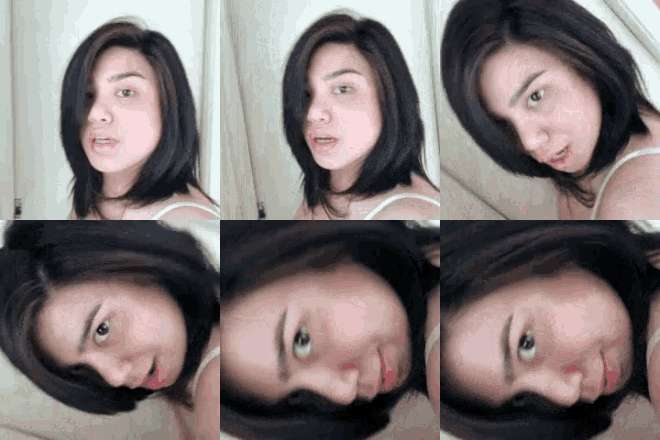
In portrait photography, an OTS variant—where the subject looks over their shoulder at the camera—is a classic pose. It creates mystery, depth, and a candid feel. It suggests the subject is caught in a moment of thought or is looking at something (or someone) just beyond the frame, inviting the viewer to wonder. This pose is incredibly effective for fashion, editorial, and lifestyle photography to avoid the static “looking-at-the-camera” stare.
In Advertising and Marketing
Advertisers use OTS to create vicarious experience. A commercial for a travel app might show an OTS of a person looking over their shoulder at a breathtaking mountain vista, with the app’s interface visible on their phone in the foreground. This instantly tells the viewer: “You could be the one having this experience, and here’s the tool that helps you.” It places the consumer in the position of the happy user.
In Video Games and Interactive Media
The OTS is a staple of third-person perspective games (e.g., The Last of Us, God of War). The camera sits directly over the protagonist’s shoulder, making the player’s view synonymous with the character’s. This creates an unparalleled sense of embodiment and control, blurring the line between player and avatar. The technique is so effective that some narrative-driven games use fixed OTS angles during key cutscenes to heighten cinematic drama.
6. Common Pitfalls and How to Avoid Them
Even experienced creators can misstep with the OTS. Here are the most frequent mistakes:
- The “Bulky Shoulder” Problem: The foreground shoulder is too large, too close, or poorly lit, becoming a distracting black blob or a dominating shape that blocks the view. Solution: Move the camera further back and use a longer lens to compress the space slightly. Ensure the foreground actor’s shoulder is turned away from the camera at a 45-degree angle to minimize its apparent size, and light it separately to separate it from the background.
- Broken Eyeline: The most jarring error. The foreground actor looks screen-left, but the camera is placed on their right. Solution: Always mark the exact spot where the background actor or “look target” will be. Have the foreground actor focus on a specific point (a dot on the wall, the camera lens itself) and lock that eyeline in during rehearsals. Use a monitor to check the match.
- Unintentional “Split”: The shot feels like two separate images glued together because the lighting on the two characters is completely mismatched (e.g., one is lit by a warm window, the other by cold fluorescents). Solution: Light the scene, not just the subjects. Use a consistent, motivated key light source that logically affects both characters, even if the fill and backlight differ slightly to maintain separation.
- Overuse and Predictability: Using an OTS for every single dialogue scene becomes visually monotonous and can drain scenes of energy. Solution: Vary your shot repertoire. Use two-shots (both characters in frame), single shots (clean singles on each speaker), insert shots of objects, and wide shots to establish context. The OTS is most powerful when used intentionally, not by default.
7. Essential Tools and Modern Innovations
While the OTS is a conceptual tool, modern technology has expanded its execution.
- Gimbals and Stabilizers: Tools like DJI RS series or Zhiyun Crane allow for smooth, fluid moving over shoulder shots. A character can walk through a hallway, and the camera can track alongside them in a dynamic OTS, creating a sense of journey and immediacy impossible with a static tripod.
- Drones: Aerial OTS shots are a breathtaking innovation. Imagine a drone flying slowly behind a character on a cliff edge, looking over their shoulder at the vast landscape. This combines the intimate POV of the OTS with epic scale.
- Mirrorless and DSLR Cameras: Their compact size and superior autofocus systems (like eye-tracking AF) are a godsend for OTS work. A camera operator can easily hand-hold a camera just behind an actor’s shoulder, and the camera will reliably keep the background subject’s eyes in critical focus, even as distances change slightly.
- Virtual Production & LED Walls: In productions like The Mandalorian, the “background” of an OTS shot might be a real-time rendered environment on a massive LED wall. This allows for perfect lighting interaction between the foreground actor (lit by practical lights in the virtual scene) and the background, solving the classic “mismatched lighting” problem in-camera.
8. The Future of the Over Shoulder Look
As visual storytelling evolves, so will this fundamental technique. We are already seeing:
- VR and 360° Video: The OTS concept is being reimagined in immersive environments. Instead of a fixed frame, the viewer can turn their head to see what the “shoulder” character sees, creating an even more powerful, embodied sense of POV.
- AI-Assisted Composition: Future camera software might use AI to automatically suggest the optimal OTS framing based on scene analysis, or even dynamically adjust the foreground element’s size in post-production to perfect the composition.
- Interactive Narrative: In choose-your-own-adventure style streaming or gaming, the OTS could be dynamically assigned. The camera might adopt the POV of whichever character the user has chosen to align with, making the technique a core part of interactive empathy.
Conclusion: The Enduring Power of a Simple Frame
The over shoulder look endures because it taps into a fundamental human experience: the act of seeing through another’s eyes. It is a visual promise of connection, a tool for building bridges between characters and, more importantly, between the story and the audience. From the silent film era to the age of streaming, it has proven that the most sophisticated emotional machinery often resides in the simplest, most elegant of frames.
Mastering the over shoulder shot is not about learning a complex new gadget; it’s about understanding visual grammar and psychological subtext. It’s about asking: Where should the camera be to make the audience feel what this character feels? When you can answer that question and execute it with technical precision, you wield a key that unlocks deeper engagement, richer storytelling, and a more professional cinematic language. So the next time you frame a shot, look over your own shoulder. You might just find the perfect angle waiting there.